
Elaine Moore’s Financial Times article, “Did AI write this? It’s getting harder to tell,” inspired this series by documenting the growing difficulty of distinguishing human prose from machine-generated text. AI laboratories are making their output more natural, while “humaniser” tools remove familiar tells. Detectors may still identify statistical patterns, but false positives remain consequential, and editing or paraphrasing can erase visible markers. As AI becomes better at imitating human prose, authorship becomes a less reliable measure of whether a report deserves reliance.13
Our viewpoint is that this difficulty should change the object of review. The controlling question is not whether a report sounds machine-generated, but whether its authorized objective is visible, its evidence can be traced, its material inferences can be tested, its uncertainty is proportionate, and an accountable human retains the final decision. Detection may open the inquiry; it cannot supply the standard of reliance.
Part I, “Detection, Prompted Bias, and Alignment,” began with detection, the most visible but least decisive question. Stylistic tells and authorship detectors may justify scrutiny, but they do not establish whether a financial analysis is accurate, unbiased, aligned with the authorized human objective, comprehensible, or logically sound. The deeper risk is that a prompt can favor a desired conclusion while every cited fact remains accurate.
Part II, “From Data to Information to Intelligence,” addressed the comprehension problem. It distinguished data from information and intelligence, then introduced inferential layering so that the controlling inference can appear before the supporting detail. Evidence-upward production disciplines how the analysis is built; evidence-outward review preserves a path from each conclusion back to the observations, calculations, classifications, and contrary evidence supporting it.
Part III, “Auditing an AI Report and Verifying its Inferences,” turned from comprehension to audit. Section 7 set out the questions a human reviewer should ask about source integrity, platform neutrality, reproducibility, confidence, decision boundaries, and accountability. Section 8 then confronted the scale problem: when thousands of inferential relationships support a report, human review may become the choke point. Formalization offers a possible division of responsibility in which humans validate the market observations, definitions, assumptions, and objectives, while a machine auditor verifies that the conclusion follows from them.
A governing standard for reliance
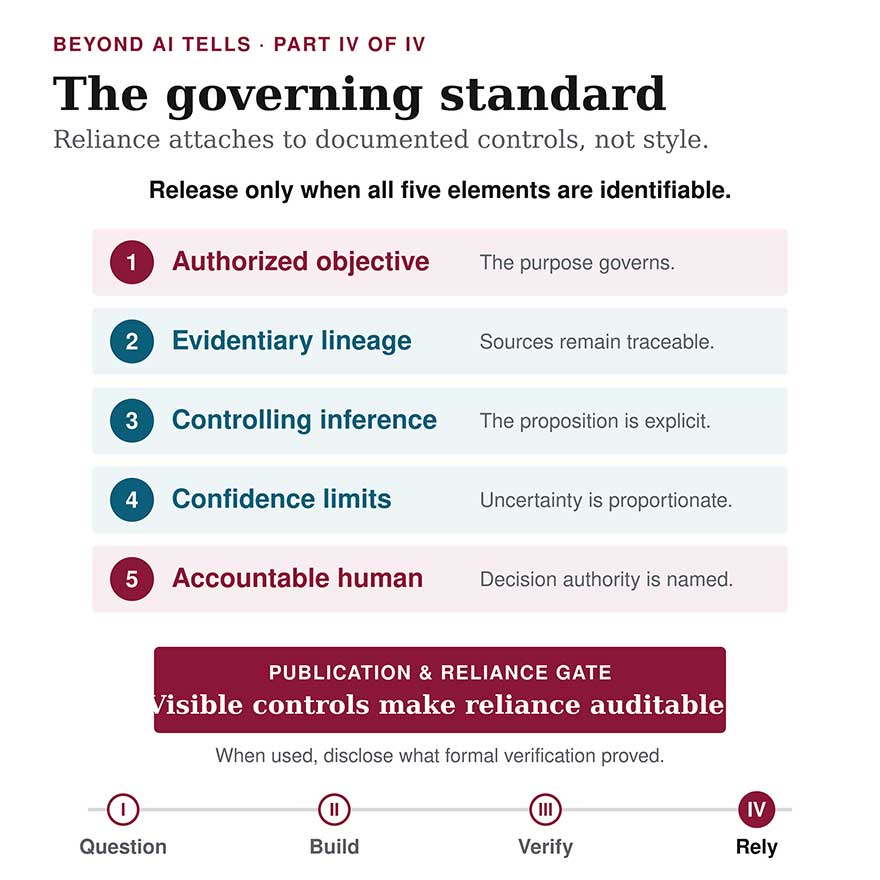
The four parts converge on one publication rule: no AI-assisted financial report should be released unless its authorized objective, evidentiary lineage, controlling inference, confidence limits, and accountable human decision-maker are identifiable. When formal verification is used, the report should also state which inferential propositions were proved and which empirical premises remain dependent upon human validation.
Reliance should attach to those documented controls, not to writing style or asserted authorship. If a report later fails, the preserved record should show whether the failure arose in the analytical question, source data, transformation, classification rule, prose, or human application. That record makes correction possible and assigns responsibility without pretending that uncertainty has been eliminated.
The disclosure should travel with the report. A board, subscriber, regulator, or trading desk should be able to distinguish a verified inference from an unverified premise, identify who approved publication, and determine where decision authority remained. These controls cannot guarantee how the market will behave. They provide a traceable basis for deciding whether the report deserves reliance.
The stakes extend beyond analytical quality. False certainty about authorship can corrode confidence in legitimate work, while undisclosed automation can produce the same result from the opposite direction. Jamir Nazir captured the resulting dilemma after his prize-winning story was accused of being AI-generated: “We trained this thing on all of our language,” he told the Financial Times. “And now it is impossible to trust each other.”13
The governing standard should therefore remain simple: use AI to extend analytical capacity, but require every material claim, exception, and responsibility to remain visible to the people asked to rely upon it.
Aristotle stated the governing discipline more than two millennia ago: the educated person knows “to look for precision in each class of things just so far as the nature of the subject admits.”14 For AI-assisted financial reporting, that discipline is no longer merely an intellectual virtue. It is a reviewer’s obligation.
Footnotes
- Elaine Moore, “Did AI write this? It’s getting harder to tell,” Financial Times, August 29, 2026. Subscription may be required. ↩︎ opening ↩︎ quotation
- Aristotle, Nicomachean Ethics, Book I, part 3, trans. W. D. Ross, The Internet Classics Archive. ↩