
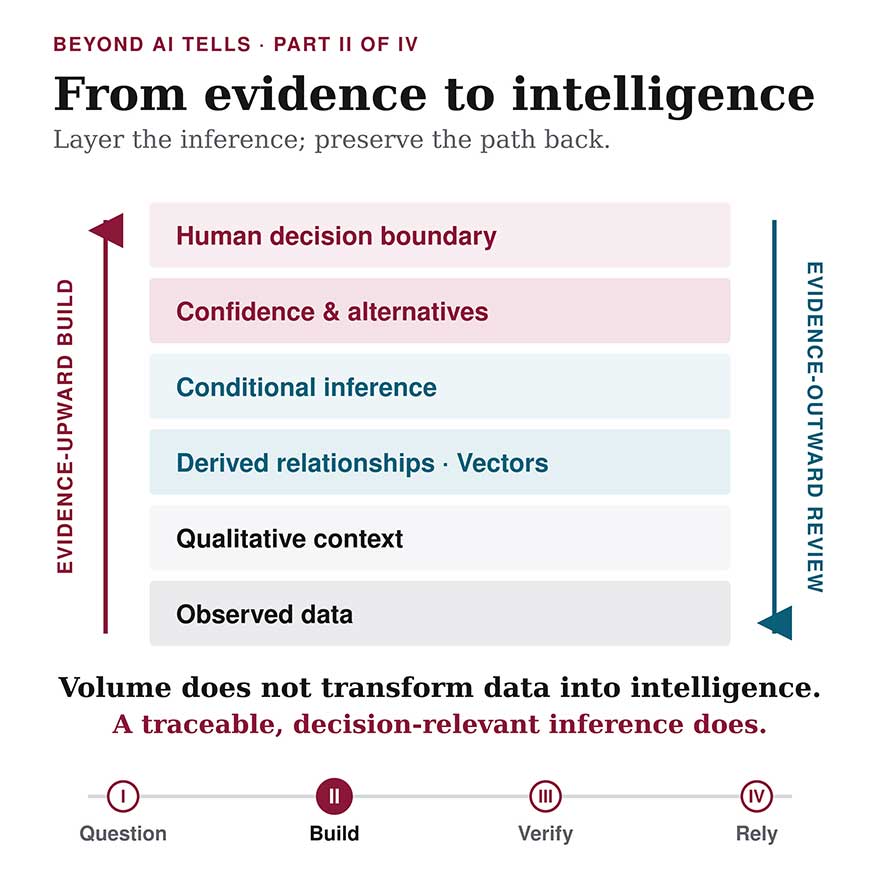
4. From data to information to intelligence
A report can avoid prompted bias and still fail its reader. Generative systems can assemble enormous quantities of accurate and relevant information at very low marginal cost. The resulting volume may exceed the attention available from the executive, trader, director, regulator, or fiduciary expected to use it.
Data, information, and intelligence should therefore be distinguished.
Data are recorded observations. In securities finance, examples include loan quantities, returns, fees, utilization, availability, collateral movements, prices, and dated transaction records.
Information organizes those observations within a relevant context. It may identify an event window, compare current activity with a prior period, describe a lockup release, or connect an unusual price movement with a corporate announcement.
Intelligence explains what the combined quantitative and qualitative information may conditionally imply. It identifies a changing relationship, states the degree of confidence, preserves competing explanations, and helps a decision-maker determine what deserves attention.
Volume does not transform data into intelligence. Accuracy alone does not do so either. A report may contain every relevant fact and still leave the executive unable to identify the condition that matters.
5. Inferential layering and executive comprehension
Inferential layering addresses this comprehension problem. It organizes the report into successive levels, allowing the executive to see the controlling inference first and inspect its evidentiary foundations when necessary.
Research on human-centered AI explanation supports this architecture. Christian Meske and his colleagues recommend a progressive information architecture that presents essential information first and permits the user to expand into deeper layers as needed. Their purpose is the same as inferential layering: to preserve access to the complete explanation without presenting every element simultaneously.7
A formulation circulating in recent discussions of AI holds that “you can outsource your thinking, but you can’t outsource your understanding.” Andrej Karpathy, an OpenAI co-founder, repeated the line at AI Ascent 2026. He described its unidentified source as “a tweet that blew my mind recently” and said he continued to think about it nearly every other day.8
The distinction is useful for financial intelligence. An AI system may perform much of the search, comparison, calculation, and drafting. The executive must still understand the controlling inference, its limitations, and the decision that remains human.
A working structure contains the following layers:
| Layer | Question answered |
|---|---|
| Observed data | What happened relative to what was expected? |
| Qualitative context | What circumstances, event features, asset types, or transaction classes shaped the observations? |
| Derived relationships or Vectors | What is changing, and which catalysts may influence the direction or magnitude of the change? |
| Conditional inferences | What may the combined evidence imply, and what range of outcomes remains plausible? |
| Confidence and alternatives | How much weight should the inference receive, and what competing Vectors could change the conclusion? |
| Decision boundary | What remains for management or the trading desk to decide, and how will the trader’s alpha be judged after applying the intelligence? |
This is not ordinary summarization. A summary compresses information and may discard qualifications. Inferential layering preserves the analytical chain while controlling how much of it the reader must consume at once.
The combined supply, demand, and marginal-fee Vectors indicate a prospective tightening state, although concentrated activity and the short observation history limit confidence.
The supporting layer would identify the observed changes in supply, demand, and fees. A deeper layer would disclose calculations, source records, classification rules, contrary indicators, and methodological limits.
The intelligence becomes easier to consume because each proposition occupies its appropriate level. The report does not force the executive to reconstruct the inference from pages of observations. It also does not hide the evidence behind a conclusion that cannot be tested.
6. Evidence-upward production and evidence-outward review
The direction of production matters. A weak report begins with a conclusion and searches for supporting information. Evidence-upward production begins with observed facts and permits each transformation, relationship, classification, and inference to extend only as far as those facts support.
Review then proceeds evidence-outward. Starting with each material inference, the reviewer traces the proposition back through its stated relationships, calculations, classifications, and sources. The two directions serve different purposes: one disciplines production; the other makes the finished analysis auditable.
New-loan activity exceeded returns during the observation window, while reported available supply declined. The marginal new-loan fee also moved above the seasoned-book fee. Together, those observations support a prospective-tightening classification. Concentrated activity and the limited observation history reduce confidence.
The passage distinguishes the observations from the classification. It identifies the relationships supporting the inference and discloses two reasons for limiting confidence. A reader can inspect the data, challenge the classification rule, or propose another explanation.
The report has become more decision-relevant without becoming a recommendation. It identifies the changing market state and explains why the condition may matter. It does not instruct a stock-loan trader to borrow, lend, return, recall, rerate, buy, or sell.
This boundary is especially important in regulated markets. A venue, data provider, consultant, or analytical service may improve a participant’s understanding without deciding how that participant should apply the information. Each stock-loan trader retains responsibility for inventory, obligations, policies, counterparties, and risk limits.
Footnotes
- Christian Meske, Justin Brenne, Erdi Ünal, Sabahat Ölcer, and Aysegül Dogangün, “Leveraging Generative AI for Human Understanding: Meta-Requirements and Design Principles for Explanatory AI as a New Paradigm,” arXiv:2508.06352v2, revised February 12, 2026. The authors recommend layered information architecture with progressive disclosure, essential information first, and user-controlled expansion into deeper explanations. ↩
- Andrej Karpathy, interviewed by Stephanie Zhan, “Andrej Karpathy: From Vibe Coding to Agentic Engineering,” AI Ascent 2026, YouTube video, 28:05-29:32, April 29, 2026. Karpathy attributed the formulation to an unidentified earlier tweet and presented the wording as approximate. ↩